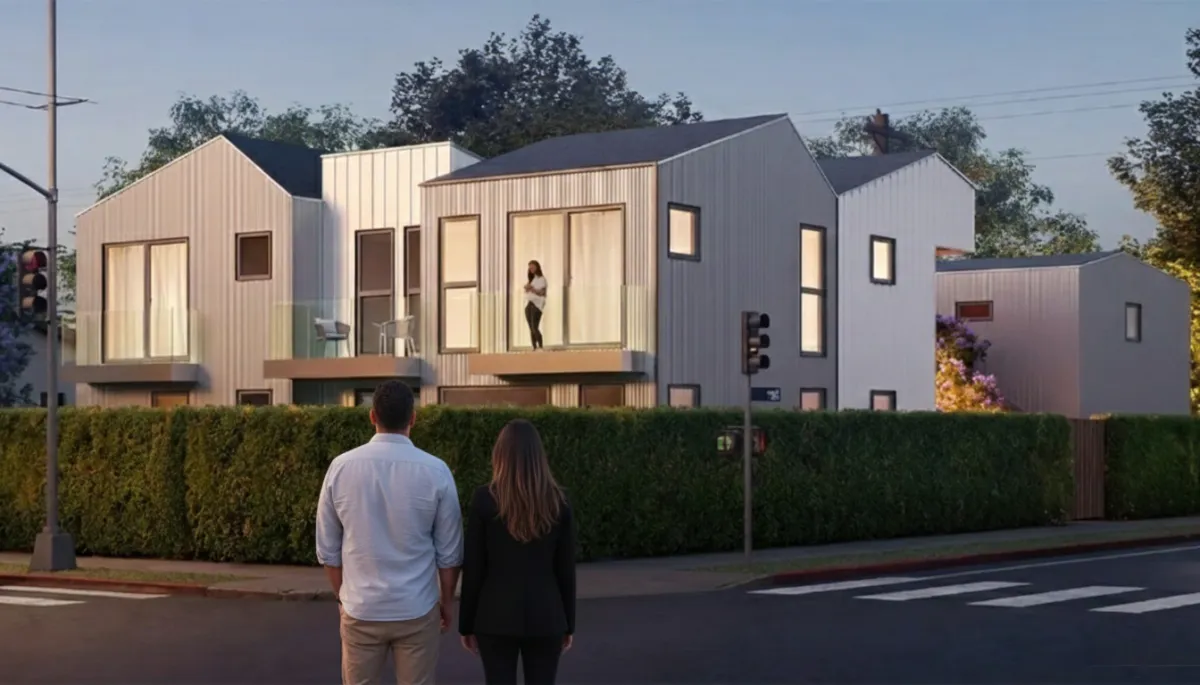
Step-by-Step Overview For Small Lot Subdivisions: How Developers Work with Architects & Engineers | Lu Kapreliants & Joseph Snyder
How SB 1123 Unlocks Small-Lot Development in California
A Step-by-Step Playbook for Developers and Investors
Most people agree that California needs more housing. Far fewer people understand how to actually build it.
That gap between intention and execution is where many affordable housing conversations fall apart. Developers feel overwhelmed by legislation. Investors worry about risk. Homeowners hear buzzwords like density and immediately picture chaos. Meanwhile, the housing shortage keeps growing.
In this episode of the Affordable Housing & Real Estate Investing Podcast, host Kent Fai He sits down with two professionals working at the front lines of California’s most important small-lot housing laws.
Luiza Kapreliants, Co-Founder of Void Design Studio, a residential architecture practice specializing in SB 9 and SB 1123 projects.
Joseph Snyder, representing Riechers Engineering, one of the most experienced firms in ministerial lot splits across California.
Together, they break down what SB 1123 actually allows, how feasibility is determined, what projects really cost, and why these laws are quietly reshaping how affordable housing can be delivered through small-scale, infill development.
If you are an investor, developer, architect, planner, or housing advocate who wants clarity instead of confusion, this episode matters.
What Is SB 1123 and Why Does It Matter for Affordable Housing?
SB 1123 expands on earlier small-lot legislation by allowing up to ten parcels to be created from a single qualifying property, provided the project meets density and zoning requirements.
The goal is not luxury sprawl. The intent is gentle density.
As Joseph explains, the state designed SB 1123 specifically to avoid scenarios where large lots are split into a handful of oversized homes that do nothing to address supply. Instead, the law requires projects to meet at least 66 percent of the underlying density standard, which often pushes developers toward higher-efficiency layouts on smaller parcels.
This matters because it creates a predictable, ministerial path to adding housing in neighborhoods that have historically been locked into single-family zoning.
For affordable housing investors, this unlocks:
Faster approvals
Fewer political hearings
Clearer underwriting assumptions
Scalable, repeatable project types
How Do Developers Determine If a Property Is Eligible for SB 1123?
Eligibility is not guesswork. It follows a defined process.
Luiza and Joseph describe a joint feasibility review that happens before a developer spends serious money. This early diligence protects capital and avoids fatal surprises later.
Key eligibility checks include:
Zoning classification, such as R-1, multifamily, or qualifying commercial mixed-use
Lot size, with most viable projects landing at or below half an acre
Existing structures, including whether a home has been rented within the last five years
Environmental overlays, including high fire hazard zones and floodplains
Access constraints, such as driveway width and fire department requirements
One important insight from the conversation is that the maximum 1.5-acre size referenced in the statute can be misleading. In practice, parcels closer to half an acre tend to pencil far better once density math and infrastructure costs are considered.
This disciplined approach to feasibility is one reason experienced teams consistently outperform first-time entrants.
What Does the SB 1123 Development Process Look Like Step by Step?
SB 1123 projects are concurrent development projects, meaning the subdivision and building design move forward together.
Joseph outlines a clear sequence:
Joint feasibility study by architecture and engineering teams
Investor-ready presentation, including site plans and cost estimates
Map submission to the city on day one
60-day municipal review window for conditions of approval
Permit submission once conditions are confirmed
Construction, often overlapping with final map recording
Because approvals are ministerial, there are no discretionary hearings. Cities must respond within statutory timelines.
This structure dramatically reduces entitlement risk, which is one of the biggest barriers to new housing production.
What Do SB 1123 Projects Actually Cost in Today’s Market?
One of the most valuable parts of this conversation is the honest discussion around costs.
Based on active projects across California:
Hard construction costs typically range from $250 to $300 per square foot, depending on finishes and delivery method
Soft costs, including engineering, architecture, and permitting, often land around $45 per square foot
All-in development costs commonly settle near $375 per square foot
Per-unit total costs often land near $750,000 for well-executed projects
Target resale values for townhome-style units range from $1.1M to $1.3M in strong submarkets
The takeaway is not that these projects are cheap. It is that they are financeable, repeatable, and profitable when done correctly.
For investors, that combination is rare in today’s housing environment.
How Do Fire, Utilities, and Infrastructure Impact Feasibility?
Infrastructure is where many deals are won or lost.
Luiza walks through real examples where fire access requirements reshaped entire site layouts. Long driveways may require fire lanes. Extended access distances may trigger mandatory fire truck turnarounds. Hydrant placement can add significant cost.
The key insight is that these issues are not surprises when teams do proper feasibility upfront.
Riechers Engineering and Void Design Studio incorporate these constraints early, allowing developers to see true costs before committing capital.
As Joseph emphasizes, infrastructure costs that feel overwhelming on a single home basis often make sense when spread across eight to ten units.
Key Insights and Frameworks from the Episode
SB 1123 is designed to create real density, not cosmetic lot splits
Half-acre parcels often outperform larger sites due to density math
Ministerial approvals dramatically reduce entitlement risk
Fire and utility requirements must be modeled early, not guessed later
These projects require experienced teams and serious capitalization
Best Quotes from the Conversation
“Everybody wants more housing. Nobody wants to be told how to do it.”
“These are not fly-by-night projects. You need a real team and real capital.”
“SB 1123 lets us build housing by right, without political theater.”
“Affordability is not just cheap housing. It is increasing overall supply responsibly.”
“Gentle density does not destroy neighborhoods. It stabilizes them.”
Common Questions This Episode Answers
Is SB 1123 only relevant in California?
Yes, the statute is California-specific, but the framework for infill density applies nationally.
Can first-time developers use SB 1123?
This is not an ideal first project. Most beginners should start with SB 9 or simpler developments.
Do cities push back on SB 1123 projects?
Pushback happens, but experienced teams handle it directly with planning departments and HCD.
Are high fire zones allowed under SB 1123?
Currently, high fire hazard zones are a deal killer for SB 1123, even though they may work for SB 9.
Is SB 1123 for rentals or for-sale housing?
Both are possible, but many current projects focus on fee-simple townhome sales.

Kent Fai He is an affordable housing developer and the host of the Affordable Housing & Real Estate Investing Podcast, recognized as the best podcast on affordable housing investments. Through in-depth conversations with practitioners actively building housing, the podcast serves as a practical education platform for investors, developers, and policymakers nationwide.
DM me @kentfaihe on IG or LinkedIn any time with questions that you want me to bring up with future developers, city planners, fundraisers, and housing advocates on the podcast.


